
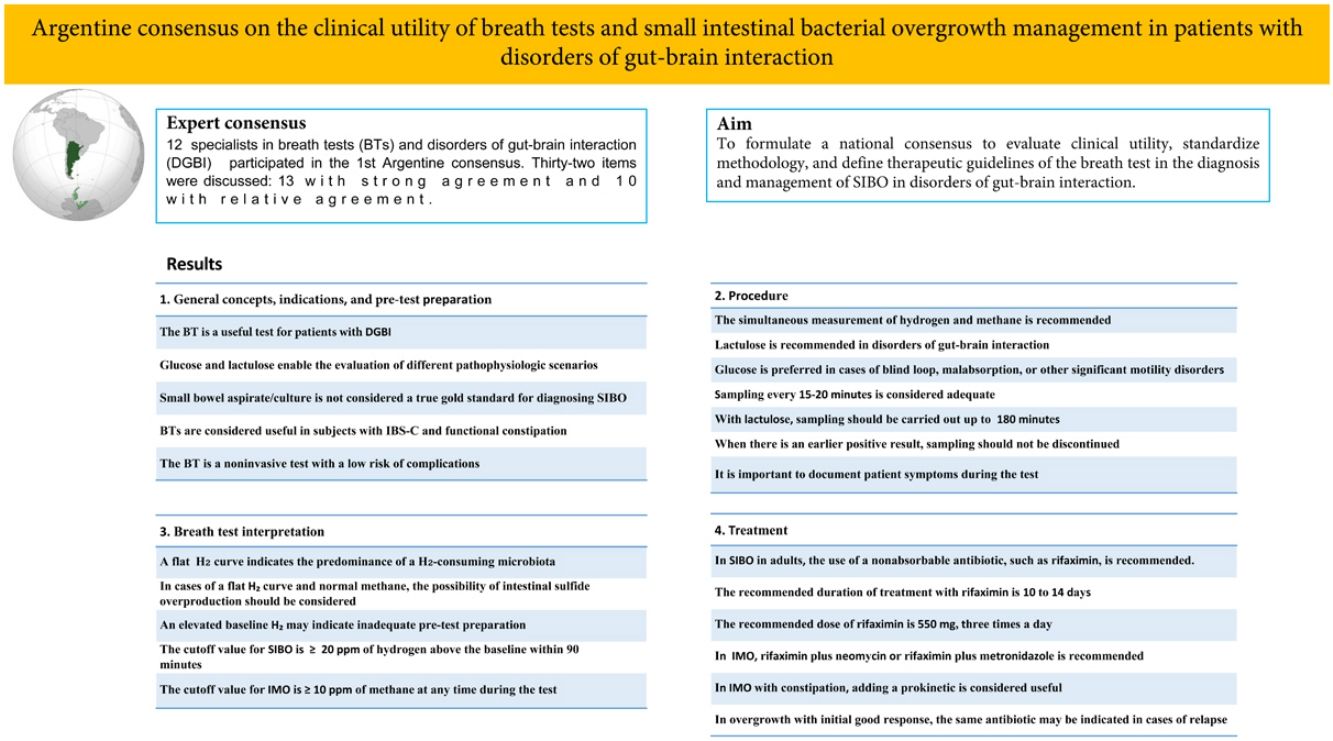
We present herein the results of a formal consensus meeting held in Argentina, whose aim was to analyze and discuss conceptual, technical, and clinical aspects related to the use of the breath test (BT) in the diagnosis and treatment of intestinal microbial overgrowth in patients with disorders of gut-brain interaction (DGBI).
Material and methodsTwelve healthcare professionals with experience in conducting BTs and treating patients with DGBI participated in an in-person meeting to discuss and vote on previously selected items.
ResultsOf the 32 items discussed, 13 reached strong agreement and 10 reached relative agreement.
Conclusions- The BT was considered a safe, useful tool in the approach to patients with DGBI.
- Application of the BT was also valuable in cases of irritable bowel syndrome with constipation.
- The simultaneous measurement of hydrogen (H2) and methane (CH4) is recommended.
- A flat-line pattern should be considered suggestive of intestinal sulfide overproduction.
- Elevated baseline H2 levels may reflect inadequate adherence to pre-test dietary preparation.
- A cutoff value of CH4 ≥ 10 ppm for diagnosing intestinal methanogen overgrowth should be considered.
- In patients with intestinal microbial overgrowth, the use of a nonabsorbable antibiotic, such as rifaximin, is recommended.
- The importance of registering patient symptoms during the test is strongly encouraged.
Se presentan los resultados de una reunión de consenso formal llevada a cabo en Argentina, cuyo objetivo fue analizar y discutir aspectos conceptuales, técnicos y clínicos relacionados con el uso del test de aire espirado (TAE) en el diagnóstico y tratamiento del Sobrecrecimiento microbiano intestinal en pacientes con trastornos de la interacción intestino-cerebro (DGBI por las siglas en inglés de Disorders of Gut-Brain Interaction).
Material y métodosDoce profesionales con experiencia en realizar el TAE y en la atención de pacientes con DGBI participaron de una reunión presencial para discutir y votar sobre ítems que fueron previamente seleccionados.
ResultadosDel total de los 32 ítems discutidos, 13 alcanzaron un acuerdo fuerte y 10 lograron un acuerdo relativo.
Conclusiones- El TAE fue considerado una herramienta útil y segura en el abordaje de pacientes con DGBI.
- Su aplicación resulta también valiosa en casos de síndrome de intestino irritable (SII) conestreñimiento.
- Se recomienda la medición simultánea de hidrógeno (H2) y metano (CH4).
- Con un patrón de línea plana deberá considerarse la posibilidad de sobrecrecimiento sulfurógeno.
- La presencia de H2 basal elevado puede deberse al incumplimiento de la preparación dietética previa al estudio.
- Para el diagnóstico de sobrecrecimiento metanógeno intestinal, se considera un valor de corte de CH4 ≥ 10 ppm.
- En pacientes con sobrecrecimiento bacteriano intestinal, se recomienda el uso de antibióticos no absorbibles como la rifaximina.
- Se enfatiza la importancia de registrar los síntomas del paciente durante la realización del test.

There is growing interest in understanding the role of the gut microbiota in the pathophysiologic mechanisms involved in disorders of gut-brain interaction (DGBI).1 They have been classified according to the Rome IV criteria, and irritable bowel syndrome (IBS), centrally mediated abdominal pain syndrome, functional abdominal bloating, functional diarrhea, and functional constipation stand out among them.1–4
Evidence shows that those disorders involve qualitative and quantitative alterations in the gut microbiota (dysbiosis).5–7 Said alterations may contribute to the development of symptoms through mechanisms, such as changes in motility, visceral sensory perception, and intestinal permeability, or through an immune response against microbial antigens present in the lamina propria of the intestinal wall.8,9 Likewise, interaction with bacterial fermentation products could also play a relevant role.10 Those alterations help explain the symptoms that frequently prompt patients to seek medical care.11,12
A predominance of small intestinal bacterial overgrowth (SIBO) is consistently found in subjects with DGBI. Traditionally, small bowel aspirate/culture has been considered the gold standard for diagnosing SIBO. However, that method has been questioned, both as a reference standard and for clinical use, due to its invasive nature, elevated cost, susceptibility to contamination, limited capacity to exclusively evaluate proximal overgrowth, and inability to cultivate archaea.13
The breath test (BT) has gained popularity as an alternative to aspirate and culture; it enables microorganism overgrowth to be indirectly estimated through the measurement of gases produced in fermentative processes. Because not only bacteria, but also archaea (as in cases of overgrowth with excessive methane [CH4] production), are involved, we prefer to call the condition “intestinal microbial overgrowth”. In the BTs, hydrogen (H2) and CH4 levels in exhaled breath are measured at regular, predetermined intervals, before and after ingesting a fermentable carbohydrate, generally glucose or lactulose.
BTs as diagnostic methods and therapeutic guides for SIBO have been questioned for different reasons, mainly due to lack of quality evidence supporting their use. Thus, consensus statements have been developed in North America,14 Europe,15–17 and Asia,18 for resolving those uncertainties, proposing methodologies and conducts that can be uniformly applied by healthcare professionals, thereby improving effectiveness, efficacy, and safety in medical decision-making.
The increasing use of BTs for diagnosing SIBO in patients with DGBI, together with advances in the understanding of the microbiota, technical and methodological aspects, new treatment regimens, and greater access to information by patients through digital communication networks, motivated us to convene the first Argentine consensus meeting. At said encounter, the best available evidence was analyzed, and in cases where there were controversies or insufficient scientific support, adequately substantiated information was obtained through the clinical expertise of the participating professionals.
AimThe aim of our work was to provide a national consensus, through an in-person meeting and the RAND/UCLA methodology, for evaluating clinical utility, standardizing methodology, and proposing therapeutic guidelines on the use of the BT in the diagnosis and management of intestinal microbial overgrowth, in patients with DGBI.
Methods- -
Aspects prior to the in-person consensus meeting
- a)
The lack of conclusive evidence on the indication of BTs in patients with DGBI for diagnosing bacterial overgrowth, as well as the existence of discrepancies in the methodology and interpretation of said tests in the local environment, were identified.
- b)
The sponsorship and collaboration of the Sociedad Argentina de Neurogastroenterología (CIDEMO) were requested for organizing the meeting.
- c)
A survey was prepared and distributed among the members of the CIDEMO to identify the most controversial aspects and eliminate those for which consensus already existed. All healthcare professionals who completed the survey were then invited to participate in the consensus meeting.
- d)
The RAND/UCLA methodology was selected for carrying out a formal consensus meeting of experts based on quantitative grading.
- -
Bibliographic search
A systematic search was carried out using the PubMed/MEDLINE, Embase, and Scopus databases, for articles published from January 1990 to October 2025, with combinations of the following terms in English and Spanish: “breath test”, “hydrogen breath test”, “methane breath test”, “small intestinal bacterial overgrowth”, “intestinal methanogen overgrowth”, “SIBO”, “lactulose/glucose breath test”, “gut-brain axis”, among others. Reviews, guidelines, consensus statements, clinical trials, and observational studies in English and Spanish were included. Two independent reviewers selected titles/abstracts and full texts, and discrepancies were resolved through consensus with the panel coordinator. International consensus statements and relevant documents identified through manual reference searching were also included.
Characteristics of the type of consensus employed- a)
Nominal group technique: This technique consists of an in-person meeting of a group of nine to 12 experts, facilitated by a coordinator, to analyze and grade a series of statements/questions. Its main advantage is enabling direct interaction among experts, although it is not exempt from opinion-leader bias. In the present consensus, 12 experts voluntarily participated. All of them previously received the background literature, and one expert was designated to analyze and present the existing level of evidence, prior to discussion of each statement/question.
The statements/questions were presented one-by-one and openly discussed. In some cases, they were reformulated to improve comprehension before the voting round. Two of the participants were in charge of analyzing the responses, according to the established format.19,20
- b)
Grading format: To obtain a quantitative evaluation, the RAND/UCLA method was used. It employs a nine-point ordinal scale for grading each recommendation. In addition, according to the degree of grade dispersion (range), the level of agreement or consensus reached was determined (Annex, Figure S1).21
- c)
Description of the grading method: Because the grading system is ordinal, the median (50th percentile) was used as the summary measure. After compiling all expert grading, the median was calculated and the response range was determined (highest and lowest values).22
- d)
Criteria for defining the level of agreement:
- -
Strong agreement: when the extreme values of the range fall within the same region of the scale (1–3, 4–6, or 7–9).
- -
Relative agreement: when the extreme values fall within two adjacent regions. In such a case, the question is discussed again and submitted to a second vote.
- -
No agreement: when the extreme values fall within non-adjacent regions. The question is discussed again and submitted to a second vote (Annex, Figure S2).
- e)
Criteria for defining the grade of recommendation:
- -
Positive recommendation: median within the 7–9 region of the scale.
- -
Negative recommendation: median within the 1–3 region of the scale.
- -
No recommendation: median within the 4–6 region of the scale.
- f)
Criteria for selecting the experts
- -
Being a gastroenterology specialist.
- -
Having at least 5 years of experience in conducting and interpreting BTs.
- -
Having conceptual and technical knowledge of the test (calibration, indications, and interpretation of results).
- -
Having experience in the treatment of patients with DGBI.
Thirty-two statements/questions were formulated and grouped into four topics for discussion and voting:
- -
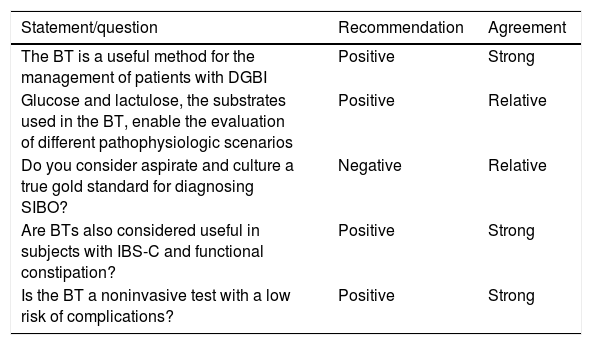
General concepts, indications, and preparation – seven items (Table 1).
Table 1.Statements/questions related to general concepts, indications, and pre-test preparation.
Statement/question Recommendation Agreement The BT is a useful method for the management of patients with DGBI Positive Strong Glucose and lactulose, the substrates used in the BT, enable the evaluation of different pathophysiologic scenarios Positive Relative Do you consider aspirate and culture a true gold standard for diagnosing SIBO? Negative Relative Are BTs also considered useful in subjects with IBS-C and functional constipation? Positive Strong Is the BT a noninvasive test with a low risk of complications? Positive Strong - -
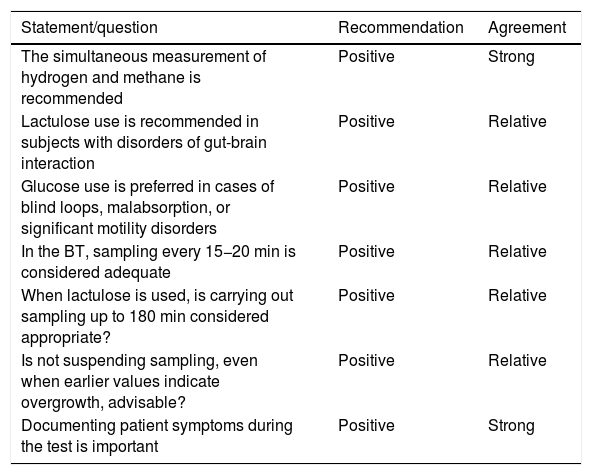
Procedure – nine items (Table 2).
Table 2.Statements related to the procedure.
Statement/question Recommendation Agreement The simultaneous measurement of hydrogen and methane is recommended Positive Strong Lactulose use is recommended in subjects with disorders of gut-brain interaction Positive Relative Glucose use is preferred in cases of blind loops, malabsorption, or significant motility disorders Positive Relative In the BT, sampling every 15−20 min is considered adequate Positive Relative When lactulose is used, is carrying out sampling up to 180 min considered appropriate? Positive Relative Is not suspending sampling, even when earlier values indicate overgrowth, advisable? Positive Relative Documenting patient symptoms during the test is important Positive Strong - -
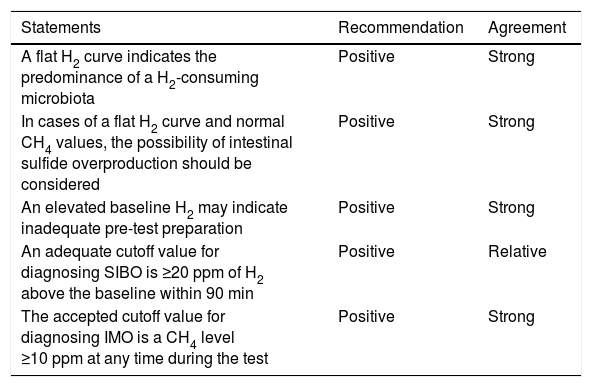
Test interpretation – six items (Table 3).
Table 3.Statements related to breath test interpretation.
Statements Recommendation Agreement A flat H2 curve indicates the predominance of a H2-consuming microbiota Positive Strong In cases of a flat H2 curve and normal CH4 values, the possibility of intestinal sulfide overproduction should be considered Positive Strong An elevated baseline H2 may indicate inadequate pre-test preparation Positive Strong An adequate cutoff value for diagnosing SIBO is ≥20 ppm of H2 above the baseline within 90 min Positive Relative The accepted cutoff value for diagnosing IMO is a CH4 level ≥10 ppm at any time during the test Positive Strong - -
Treatment – 10 items (Table 4).
Table 4.Statements related to treatment.
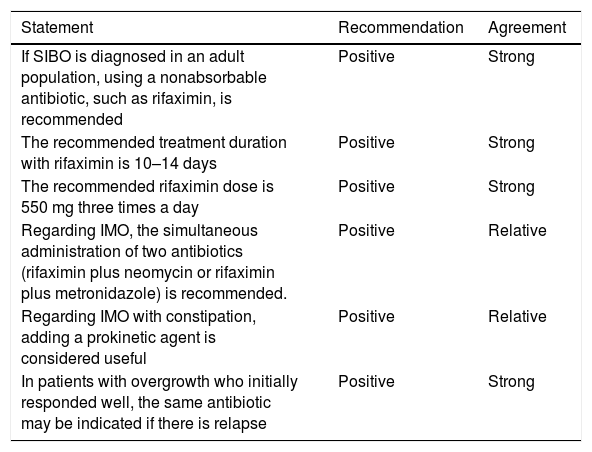
Statement Recommendation Agreement If SIBO is diagnosed in an adult population, using a nonabsorbable antibiotic, such as rifaximin, is recommended Positive Strong The recommended treatment duration with rifaximin is 10–14 days Positive Strong The recommended rifaximin dose is 550 mg three times a day Positive Strong Regarding IMO, the simultaneous administration of two antibiotics (rifaximin plus neomycin or rifaximin plus metronidazole) is recommended. Positive Relative Regarding IMO with constipation, adding a prokinetic agent is considered useful Positive Relative In patients with overgrowth who initially responded well, the same antibiotic may be indicated if there is relapse Positive Strong
The ranges and medians for each of the 32 statements/questions are described in the Annex section (Tables S1, S2, S3, S4)
ResultsOf the 32 statements/questions evaluated
- -
Thirteen (40.6%) reached strong agreement with a positive recommendation, corresponding to statements with ample agreement between experts and clear support for the statement.
- -
Ten (31.3%) showed relative agreement, with nine positive recommendations and one negative recommendation, corresponding to statements with partial agreement, but a clear trend reflecting a majority expert opinion.
- -
Six (18.8%) did not reach agreement, but issued four positive recommendations and two negative recommendations, corresponding to statements that elicited very heterogeneous opinions, not reaching a clear consensus among the experts, but with sufficient inclination to grade their utility or validity as positive or negative.
- -
Three (9.4 %) reached no agreement or recommendation, i.e., no consensus was reached nor could a group position on the statements be defined.
- a)
Statements with strong agreement and positive recommendation:
- -
The BT is considered a useful method for managing patients with DGBI.
- -
BTs are also useful in subjects with constipation-predominant IBS (IBS-C) and functional constipation.
- -
The BT is noninvasive and has a very low risk of complications.
- -
Simultaneous measurement of H2 and CH4 is preferred.
- -
A flat H2 curve implies the predominance of a H2-consuming microbiota.
- -
When H2 curves are flat and CH4 values are normal, the possibility of intestinal sulfide overproduction should be considered.
- -
Elevated baseline H2 may indicate inadequate adherence to pre-test diet and/or fasting requirements.
- -
An adequate cutoff value for intestinal methanogen overgrowth (IMO) is ≥10 ppm at any time during the test.
- -
It is important to register patient symptoms during the test.
- -
For the treatment of SIBO in adults, employing a nonabsorbable antibiotic, such as rifaximin, is advisable.
- -
The recommended rifaximin dose is 550 mg three times a day.
- -
The recommended duration of rifaximin therapy is 10–14 days.
- -
In patients with bacterial overgrowth who initially responded well, the same antibiotic may be indicated in cases of relapse.
- b)
Statements with relative agreement and positive recommendation:
- -
Glucose and lactulose evaluate different pathophysiologic conditions.
- -
The use of lactulose is preferred in subjects with DGBI.
- -
The use of glucose is preferred in cases of blind loop, malabsorption, or significant motility disorders.
- -
Sampling every 15−20 min is considered adequate.
- -
When lactulose is employed, sampling should continue up to 180 min and not be suspended, even if earlier values suggest intestinal bacterial overgrowth.
- -
A cutoff value for SIBO ≥ 20 ppm of H2 above the baseline level within the first 90 min is considered adequate.
- -
In cases of IMO, the simultaneous use of two antibiotics (rifaximin plus neomycin or rifaximin plus metronidazole) is recommended.
- -
In cases of IMO with constipation, adding a prokinetic agent is considered useful.
- c)
Statements of relative agreement and a negative recommendation:
- -
The aspirate and culture method is not considered a true gold standard for diagnosing SIBO.
- d)
Statements with no agreement but with a positive recommendation:
- -
Calculating the area under the curve (AUC) is considered useful.
- -
If breath samples are stored, they should be processed the same day.
- -
Exclusive H2 measurement may increase the number of false negatives.
- -
In cases of SIBO associated with IBS, a low fermentation diet is advisable for symptom improvement.
- e)
Statements with no agreement and a negative recommendation:
- -
Performing a BT after treatment to evaluate its efficacy is not recommended.
- -
Proton pump inhibitors (PPIs) should not be suspended prior to a BT.
- f)
Statements with no agreement and no recommendation:
- -
There was no agreement or recommendation on modifying the duration of treatment with rifaximin, according to the severity of SIBO.
- -
There was no agreement or recommendation on probiotic use after completing antibiotic therapy.
- -
There was no agreement or recommendation on prebiotic use in SIBO.
Following below is a detailed description of each of the statements formulated for this consensus. They are grouped into the thematic axes defined for the meeting: General concepts, indications, and preparation; Procedure; Test interpretation; and Treatment, showing the level of agreement and the type of recommendation reached. In this section, negative recommendations are phrased as questions to avoid confusion with the positive recommendations.
General concepts, indications, and preparation (Table 1)- 1
The BT is a useful method for managing patients with DGBI. Strong agreement and Positive recommendation.
Although there are conflicting opinions on the usefulness of the BT in functional gastrointestinal disorders, the expert group coincided in considering it a valuable tool, supported by the direct experience of the participants in the systematic performance and interpretation of said tests.
Despite the fact that some studies have questioned the usefulness of the BT due to variability in orocecal transit time, observed in tests with both lactulose23,24 and glucose,25 the present consensus recognizes that the BT provides information that other tests do not. In particular, it enables the identification of IMO, a diagnosis that can only be made through said test, making it possible to adjust antibiotic treatment according to the presence of SIBO, IMO, or both. Without a doubt, the BT has both advantages and limitations that must be taken into account in a clinical context. The identification of different patterns, such as the presence of flat-line H2 and CH4 and/or elevated baseline H2, enhances its usefulness in the management of patients with DGBI.26
- 2
Glucose and lactulose, the substrates used in the BT, enable the evaluation of different pathophysiologic scenarios. Relative agreement and Positive recommendation.
Glucose is a monosaccharide that is absorbed in the proximal small intestine, albeit in cases of accelerated transit, it can reach the colon. In contrast, lactulose, because it is a nonabsorbable disaccharide, enables the detection of the bacterial contact in both the small intestine and colon.27,28
In their review, Khoshini et al. analyzed the diagnostic accuracy of BTs with lactulose and glucose, compared with culture. The sensitivity of glucose varied between 20% and 93%, with a specificity of 30%–86%, whereas lactulose had a sensitivity of 31%–68% and a specificity of 44%–100%.29 A meta-analysis concluded that glucose has greater sensitivity and specificity than lactulose: they evaluated 14 studies, determining sensitivity of 42.0% and 54.5% and specificity of 70.6% and 83.2% for lactulose and glucose, respectively.30
Another meta-analysis compared sensitivity and specificity of the BT with different substrates in patients with IBS, reporting 72.2% sensitivity and 66% specificity for lactulose. For glucose, sensitivity was considerably lower (15.7%) and specificity reached 97%, indicating a great capacity for ruling out false positives.31 In summary, although glucose has high specificity, its sensitivity is low, and so a positive test with glucose confirms the presence of SIBO but a negative result does not rule it out. In contrast, lactulose has higher sensitivity but limited specificity, resulting in a high positive result rate, reinforcing the need for cautious interpretation.32,33
During the meeting, the fact that most of the studies evaluating BT accuracy compared their results with intestinal aspirate and culture, a method no longer considered a true gold standard, was discussed. That limitation is crucial, given that the reported sensitivity and specificity for glucose and lactulose are based on a reference standard with numerous restrictions, such as those addressed in the next section.
The microorganisms found in the intestine of subjects with SIBO may vary, depending on the underlying pathophysiologic mechanism.34–36 For example, in cases of hypochlorhydria or the prolonged use of PPIs, there is a predisposition to SIBO with Gram-positive flora, whereas the mechanisms related to anatomic alterations (blind loop, diverticulosis) or with significant motility disorders that compromise bacterial clearance predispose to SIBO with a predominance of Gram-negative microorganisms.37
It was also noted that when lactulose reaches the colon early due to accelerated orocecal transit, the measured gases could reflect colonic fermentation rather than SIBO. This implies that in certain cases, lactulose may evaluate colonic fermentative activity rather than the exclusive presence of SIBO.
- 3
Is it appropriate to consider aspirate and culture a true gold standard for the diagnosis of SIBO? Relative agreement and Negative recommendation.
The consensus concluded that intestinal aspirate and culture should not be regarded as a gold standard for diagnosing SIBO. Historically, that method has been used as the reference for determining sensitivity and specificity of glucose or lactose-based BTs. However, as previously stated, it has numerous limitations: it is invasive and costly, only a small number of microorganisms can be cultured, samples are obtained solely from the proximal small bowel segments, and there is a risk of contamination. Cutoff values have also varied over time, from >105 CFU/mL to > 103 CFU/mL, explaining the different criteria employed across studies.38
Despite those limitations, a study based on gene sequencing (rRNA) found that a culture with a threshold of >103 CFU/mL correlated well with clinical symptoms, BT results, and gene sequencing.39 Nevertheless, there is not enough evidence for considering the method a true gold standard.
- 4
Is the post-treatment performance of a BT to evaluate its therapeutic efficacy recommendable? No agreement and Negative recommendation.
The routine performance of a BT for monitoring SIBO resolution is not recommended, given that clinical improvement may be sufficient for evaluating treatment response. Test repetition may be considered only in cases of persistent symptoms or early relapse, following the guidelines that suggest the indication of a new BT under those circumstances.
- 5
BTs are also considered useful in subjects with IBS-C and functional constipation. Strong agreement and Positive recommendation.
Patients with IBS, specifically those with IBS-C, present with SIBO and/or IMO more frequently,40 which may contribute to gastrointestinal dysfunction and symptom persistence.
In such cases, the BT is useful for diagnosing overgrowth as a potential underlying cause or contributing factor.
The evaluation of excessive CH4 production is recommended in patients with constipation, with or without abdominal pain, because IMO has been associated with intestinal motility disorders. However, the BT is not considered an adequate method for evaluating orocecal transit time.41
- 6
Is suspending PPIs before performing a BT recommendable? No agreement and Negative recommendation.
This was the only recommendation that did not achieve consensus in the preliminary survey, nor did it achieve agreement at the in-person meeting, but a negative recommendation was issued. Even though PPIs may cause dysbiosis and SIBO, as recognized in other consensus statements, their discontinuation before a BT is not recommended.
- 7
The BT is a noninvasive test with a low risk of complications. Strong agreement and Positive recommendation.
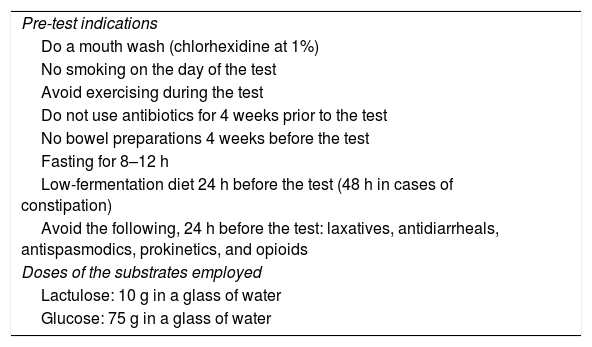
The BT requires ingesting a solution of glucose or lactulose, fermentable substrates that may produce mild gastrointestinal discomfort, such as bloating, diarrhea, pain, or a swelling sensation. To ensure result validity and minimize interference, an 8–12-h fasting period before the test is recommended (Table 5).
Recommendations before and during the test and the recommended substrate doses.
| Pre-test indications |
| Do a mouth wash (chlorhexidine at 1%) |
| No smoking on the day of the test |
| Avoid exercising during the test |
| Do not use antibiotics for 4 weeks prior to the test |
| No bowel preparations 4 weeks before the test |
| Fasting for 8–12 h |
| Low-fermentation diet 24 h before the test (48 h in cases of constipation) |
| Avoid the following, 24 h before the test: laxatives, antidiarrheals, antispasmodics, prokinetics, and opioids |
| Doses of the substrates employed |
| Lactulose: 10 g in a glass of water |
| Glucose: 75 g in a glass of water |
In the specific case of glucose, its rapid absorption in the proximal small intestine may cause a transitory increase in blood glucose, which is especially relevant for diabetic patients, who must control their glucose levels to prevent episodes of hyperglycemia or hypoglycemia.42
Procedure (Table 2)- 8
The simultaneous measurement of H2 and CH4 is recommended. Strong agreement and Positive recommendation.
Around 35% of healthy subjects harbor CH4-producing microorganisms (archaea) in their intestine.43 Said archaea consume H2 to produce CH4, which is why increased CH4 excretion in breath samples tends to coincide with a reduction in H2 excretion. Basing results solely on normal H2 values may underestimate the presence of competing H2-consuming microorganisms and mask H2-producing microorganisms.44 Therefore, only measuring exhaled H2 may lead to interpreting the test as normal, even though there is overgrowth of other microbes. On the other hand, elevated H2 does not rule out simultaneous overgrowth of methanogenic archaea, a situation that requires a different treatment regimen.
Clinical and experimental studies indicate that CH4 acts as a gastrointestinal motility inhibitor and that its concentration correlates inversely with stool form and frequency, as well as with constipation severity.45,46 Excess CH4 excretion, predominantly due to Methanobrevibacter smithii, is measured through a BT and an accepted cutoff value is ≥10 ppm. This phenomenon is known as IMO, but the criterion for defining excessive CH4 production is not as precise as that with H2. In patients with elevated CH4, values tend to be higher at the baseline and elevations during the test are not as obvious as with H2.47,48
- 9
Lactulose is recommended in subjects with DGBI. Relative agreement and Positive recommendation.
The role of SIBO in the pathogeny of DGBI, such as IBS, is a subject of debate.49 A systematic review and meta-analysis concluded that SIBO was more frequent in IBS than in controls, with an odds ratio (OR) of 4.9. Based on cultures, 35% of the subjects with IBS presented with SIBO, compared with 8.3% of the controls. In addition, the use of lactulose as a substrate offered greater diagnostic yield, compared with culture and glucose.50 Most of the present consensus experts expressed a preference for lactulose use in subjects with DGBI because it allows both early (small intestine) and late (ileum and colon) intestinal fermentation to be assessed, considering that late fermentation could be more prevalent in patients with DGBI.
- 10
Glucose is preferred in cases of blind loop, malabsorption, or other significant motility disorders. Relative agreement and Positive recommendation.
The term “small intestinal bacterial overgrowth” or SIBO was originally coined to describe cases of malabsorption in patients with anatomic or functional gastrointestinal alterations, such as postoperative blind loops, fistulas, jejunal diverticula, or chronic intestinal pseudo-obstruction.
In studies employing small-bowel aspirate and culture as the reference pattern, the glucose BT has been suggested to have higher sensitivity and specificity than the test with lactulose.51
Therefore, albeit with relative agreement, glucose is recommended particularly in patients with classic SIBO associated with severe symptoms, malnutrition, or overt malabsorption.
- 11
In the BT, sampling every 15−20 min is considered adequate. Relative agreement and Positive recommendation.
In the BT, sampling frequency should follow a standard protocol to guarantee accurate results. The procedure consists of taking a baseline breath sample before ingesting the substrate (glucose or lactulose) and then continuing with the collection at regular intervals, usually every 15−20 min, to adequately register the variations in gas production.52,53
- 12
In the BT with lactulose, sampling should be carried out for up to 180 min. Relative agreement and Positive recommendation.
In glucose breath tests, the result tends to be obtained within the first 90 min, with some authors suggesting the test can be completed at that time. However, when lactulose is used, the arrival of the substrate into the colon enables the fermentative response in the distal segments (ileum and colon) to be evaluated, which can only be observed if sampling extends up to 180 min.54
- 13
Not discontinuing sampling, even if earlier values indicate overgrowth, is advisable. Relative agreement and Positive recommendation.
As stated before, especially when lactulose is the substrate, extending the test up to 180 min allows a comprehensive fermentation profile to be established, which is useful if the AUC of total gas excretion is to be calculated.
- 14
Calculating the AUC is considered useful. No agreement but Positive recommendation.
This item did not reach the required consensus level. However, the panel decided to issue a positive recommendation, given that several members were of the opinion that the AUC could provide clinically valuable complementary information.
The AUC analysis is advantageous,55,56 given that instead of being based on a cutoff value (increase in H2 ≥20 ppm above the baseline in 90 min and CH4 ≥10 ppm), gas production can be quantified over time, offering a more complete view of the bacterial metabolic activity in the intestine.
This is especially useful for differentiating transient elevated gas levels from sustained levels, as well as for identifying findings that may not be apparent with an approach based solely on fixed thresholds.
Some patients with microbial overgrowth may not meet the diagnostic criteria of SIBO/IMO but have mild, sustained increases throughout the test, which could be detected by the AUC. Not all alterations observed in the BT are strictly consistent with SIBO; some cases may reflect another type of intestinal dysbiosis, and in such settings, the AUC could be a useful tool for their detection.
Likewise, in the follow-up assessment, a BT that shows a decrease in the AUC after treatment could more accurately reflect clinical improvement than the analysis based solely on absolute gas values.
In patients with rapid or delayed bowel transit, the elevation of gas levels could occur earlier or later than expected; in such cases, the AUC may be a more robust measurement by not depending on the exact time of the increase.
The AUC could also contribute to the interpretation of prolonged BTs (>120 min), for which there are no internationally accepted reference values. In the methanogenic phenotypes, the AUC has been shown to be useful for quantifying CH4 production and correlating it with constipation severity,57 better reflecting its impact by occurring in a sustained or plateau-like manner.58
- 15
If exhaled breath samples are to be stored, they should be processed the same day. No agreement but Positive recommendation.
Volatile compounds, such as H2 and CH4, can slowly diffuse through the walls of the collection tubes or chemically react if they are not properly sealed, potentially altering results. Therefore, the recommendation is to process the samples the same day they are collected. However, in some cases, they may be temporarily stored if they meet certain criteria: they must be collected in hermetically sealed containers (plastic syringes are the most widely used device) and stored in refrigeration to minimize diffusion and microbial activity. Under those conditions, they can remain stable for approximately 24−48 h, but beyond that amount of time, the accuracy of the results may be compromised.59 Temperature fluctuations during storage or transport can also cause the gases to expand or contract, altering their concentration.60 Hydrogen is known to dissipate faster than CH4 due to its greater reactivity and diffusibility.61–63 Nevertheless, in other studies, no significant difference in H2 concentrations between samples analyzed early and those analyzed late was observed, but CH4 concentrations showed a significant increase in samples stored for a longer time.64
- 16
It is important to document patient symptoms during the test. Strong agreement and Positive recommendation.
In some patients with DGBI, there may be dysfunctions in central and peripheral control mechanisms of visceral sensory perception.65,66 When a poorly absorbed carbohydrate reaches the colon, its metabolism produces gases and short-chain fatty acids, which may trigger symptoms of pain, bloating, or diarrhea. Said symptoms are not always due to microbial overgrowth, but rather to individual intolerance to intestinal fermentation.67–69 In that context, nonabsorbable lactulose BTs may provide the added value of evaluating patient symptoms regardless of the quantity of excreted gases. Specific questionnaires for adults and children have been developed and validated for adequate symptom assessment.70,71
Breath test interpretation (Table 3)- 17
The exclusive measurement of H2 may increase the number of false negatives. No agreement but Positive recommendation.
It is important to simultaneously measure H2 and CH4. Methanogenic archaea utilize four moles of H2 to produce one mole of CH4, and so elevated CH4 levels may reduce H2 values in exhaled breath. As previously stated, if only H2 is measured, the result may be erroneously interpreted as normal when it is not. In addition, a sulfide-producing microbiota, dietary sulfate, or an acidic colonic pH72 may reduce H2 excretion by up to 20%, increasing the possibility of false negative results.73
- 18
A flat H2 curve indicates the predominance of a H2-consuming microbiota. Strong agreement and Positive recommendation.
Minimal H2 excretion, previously attributed to the predominance of non-H2-producing microorganisms, is currently interpreted as a consequence of the predominance of H2-consuming microorganisms. The “flat-line” pattern is defined as stable H2 production, ≤3 ppm, with no increases >1 ppm above the baseline and in the absence of CH4.74,75
- 19
In cases of a flat H2 curve and normal CH4 values, the possibility of intestinal sulfide overproduction should be considered. Strong agreement and Positive recommendation.
When a “flat-line” pattern is identified (defined as low H2 production in the absence of CH4), a predominantly non-methanogenic H2-consuming microbiota is supposed, i.e., H2 consumption is caused by hydrogen sulfide (H2S)-producing microorganisms.76
- 20
An elevated baseline H2 may indicate inadequate pre-test preparation. Strong agreement and Positive recommendation.
“Elevated baseline H2” is defined as a H2 value ≥20 ppm in a lactulose or glucose BT before substrate ingestion. Elevated H2 levels related to inadequate adherence to the pre-test low fermentation diet or insufficient fasting time are commonly observed, and so if those conditions cannot be guaranteed, repeating the test is recommended. Nevertheless, depending on the context, when there is strong clinical suspicion, said pattern may be interpreted as suggestive of intestinal microbial overgrowth.77,78
- 21
An adequate cutoff value for diagnosing SIBO is an elevation ≥20 ppm of H2 above the baseline value within 90 min. Relative agreement and Positive recommendation.
Some of the consensus experts questioned the specificity of the 20 ppm threshold for H2, citing potential false positives due to physiologic variations or rapid bowel transit. However, that value continues to be widely accepted for its simplicity and clinical applicability.79 Regarding lactulose, the double-peak diagnostic criterion (traditionally interpreted as one attributed to SIBO and the other to colonic fermentation) is no longer considered necessary. During our meeting, increases from 12 to 19 ppm above the baseline value were proposed as “borderline or inconclusive”, and in such cases, the presence of typical symptoms (diarrhea, bloating, or abdominal pain) during the first 90 min, could serve as an additional support criterion for diagnosing overgrowth.
- 22
The accepted cutoff value for diagnosing IMO is a CH4 level ≥10 ppm at any time during the test. Strong agreement and Positive recommendation.
The optimum criterion for defining excessive CH4 excretion is not exact, a point on which the experts coincided. However, until new evidence is produced, the suggested cutoff value for a CH4-positive BT is a level ≥10 ppm at any time during the test. According to Shaker et al., 96.4% of the CH4-positive tests (IMO) were identified within the first 90 min, regardless of the baseline values. Based on those findings, some researchers suggest that measuring can be stopped at 90 min, but others recommend extending the test up to 180 min, especially when lactulose is used and H2 and CH4 are simultaneously measured.80
During the expert panel discussion, certain technical aspects, such as the type of instrumentation and calibration gases utilized, were posited to influence the cutoff values for defining IMO. To reduce false positives, an “unequivocal diagnosis” of IMO, when two or more measurements of CH4 are ≥ 15 ppm within the first 90 min, was suggested.
Treatment (Table 4)- 23
If SIBO is diagnosed in an adult population, using a nonabsorbable antibiotic, such as rifaximin, is recommended. Strong agreement and Positive recommendation.
SIBO is not a disease per se but rather a syndrome that responds to an underlying disease that must be identified and treated. Management of the predisposing disorders not only helps alleviate condition symptoms but also prevents recurrence after successful treatment. Thus, detecting and adequately treating those predisposing conditions is essential.81,82
Even though there are different strategies for controlling SIBO, rifaximin is the most widely studied broad-spectrum antibiotic.83,84 Other antibiotics have also been studied, including norfloxacin, ciprofloxacin, metronidazole, doxycycline, neomycin, cotrimoxazole, and amoxicillin with clavulanic acid.
Rifaximin, a structural rifampicin analogue, inhibits bacterial RNA synthesis by binding to polymerase RNA. It is a nonabsorbable antimicrobial, efficacious against aerobic, anaerobic, Gram-positive, and Gram-negative bacteria. In May 2015, the FDA approved rifaximin for the treatment of IBS-D.85 It has a favorable safety profile because it does not create resistance, its systemic absorption is minimal (0.5%), its toxicity level is low, there are few adverse effects, and few medication interactions. Its main limitation is its higher cost, in relation to other antimicrobials.86
A meta-analysis of 10 studies (Shah, et al.) included 1,356 patients and primarily evaluated rifaximin use (eight studies). The general BT normalization rate with rifaximin was 49.5% (95% CI 44.0–55.1). Other antibiotics, such as metronidazole, neomycin, and ciprofloxacin, were also efficacious, with a combined BT normalization rate of 51.1% (IC 95% CI 46.7–55.5) for the antibiotics, compared with 9.8% (95% CI 4.6–17.8) for placebo. A meta-analysis of four studies in that review favored antibiotics over placebo for BT normalization, with an odds ratio of 2.55 (95% CI 1.29–5.04).87
Likewise, a recent systematic review analyzed six studies that compared the efficacy of antibiotics compared with placebo in a total of 196 patients with SIBO, 101 of whom received antibiotics and 95 received placebo or no treatment. Clinical improvement was significantly better in the antibiotic group (relative risk [RR] [95% CI] of 2.46 [1.33–4.55], p = 0.004).88
- 24
The recommended duration of treatment with rifaximin is 10–14 days. Strong agreement and Positive recommendation.
The 10–14-day duration of treatment with rifaximin was widely agreed upon, concurring with the leading international guidelines. Even though comparative studies on optimal treatment duration are limited, all therapeutic regimens proposed in the literature agree on that time range.89
- 25
The recommended rifaximin dose is 550 mg three times a day. Strong agreement and Positive recommendation.
The rifaximin dose of 550 mg three times a day is supported by the TARGET I and TARGET II clinical trials. In those phase 3, double blind, placebo-controlled trials, patients with IBS without constipation received 550 mg of rifaximin versus placebo, three times a day for two weeks, and were followed for 10 additional weeks. A significantly higher percentage of patients treated with rifaximin experienced adequate overall IBS symptom relief during the first four weeks post-treatment, compared with the placebo group: TARGET I: 40.8% vs 31.2% (p = 0.01), TARGET II: 40.6% vs 32.2% (p = 0.03) and the combined analysis: 40.7% vs 31.7% (p = 0.001). All patients treated with rifaximin had bloating, abdominal pain, and stool consistency improvement.90
Even though there are studies with rifaximin at a dose of 400 mg every 8 h, current evidence supports the use of 550 mg every 8 h as the most effective dose, a criterion widely accepted by specialists.
- 26
The duration of treatment with rifaximin is modified according to the severity of SIBO. No agreement and No recommendation.
No agreement was reached or recommendation issued on whether patients with elevated gas levels in the BT could require longer treatment duration. The intestinal microbiota is highly dynamic and may experience significant changes in short periods of time, making it difficult to define severity in SIBO solely in relation to isolated gas measurements. Even though elevated values could suggest greater fermentation, and in turn, greater severity of the condition, there are no studies that justify modifying the duration of treatment with rifaximin, based on BT results.
- 27
In cases of IBS-associated SIBO, a low fermentation diet is advisable for symptom improvement. No agreement but Positive recommendation.
Even though complete agreement on this theme was not reached, a positive recommendation was issued. Dysbiosis associated with SIBO produces an increase in intestinal fermentative activity, which increases with the presence of more fermentable substrates, such as carbohydrates. Therefore, restricting those foods makes sense as symptomatic treatment in patients with SIBO and IBS.
The low fermentable oligosaccharide, disaccharide, monosaccharide, and polyol (FODMAP) diet has been widely studied and has shown efficacy in the treatment of IBS. The first study that evaluated its impact through a double-blind challenge with fructans confirmed the benefits of said restriction in patients with IBS. However, its utility in the treatment of SIBO is still limited. Some studies have explored the impact of different diets on the condition, but their low methodological quality hinders the extrapolation of the results to clinical practice. Therefore, at present, there is insufficient scientific evidence supporting a specific diet as treatment of SIBO.91
- 28
Regarding IMO, the simultaneous administration of two antibiotics (rifaximin plus neomycin or rifaximin plus metronidazole) is recommended. Relative agreement and Positive recommendation.
In a study conducted on patients with IMO, the combination of rifaximin plus neomycin was superior to the administration of either antibiotic alone. Eighty-five percent of the subjects who received rifaximin plus neomycin had clinical response, compared with 63% in the group that received neomycin alone (n = 8) (p = 0.15) and 56% in the group that received rifaximin alone (n = 39) (p = 0.01). There were no significant differences in the comparison of the neomycin and rifaximin groups. When CH4 eradication was evaluated in the BT, the results were 87% for the rifaximin plus neomycin combination, 33% for neomycin alone, and 28% for rifaximin alone.92
In another study, rifaximin plus neomycin was superior to neomycin alone in improving symptoms in patients with IBS-C and a CH4-positive BT. Constipation severity was significantly lower in the rifaximin plus neomycin group (28.6 ± 30.8), compared with the group receiving neomycin alone (61.2 ± 24.1) (p = 0.0042).93
The expert panel recommended metronidazole as a substitute for neomycin, in cases of intolerance, contraindication, or inability to prescribe it.
- 29
Probiotics may be used after completing treatment with antibiotics. No agreement and No recommendation.
No agreement was reached or recommendation issued on this theme, given a lack of robust evidence justifying their systematic use in the treatment or prevention of SIBO.
Even though probiotics may modify the gut microbiota, the available evidence is heterogeneous and low-quality, with disparate results among studies.
In a systematic review with a meta-analysis that included 14 full articles and eight abstracts, probiotics showed a nonsignificant trend toward a lower incidence of SIBO (RR = 0.54; 95% CI 0.19–1.52; p = 0.24). The SIBO eradication rate was 62.8% (51.5–72.8 %) and reached 85.8% when probiotics and antibiotics were combined, compared with the 53.2% with probiotics alone. There was also a significant decrease in H2 concentration (95% CI −44.23 to −28.47 ppm; p < 0.05) and improved abdominal pain, with no relevant changes in stool frequency.
In conjunction, those findings suggest that probiotics may be useful as adjuncts in the treatment of SIBO, but there is no conclusive evidence justifying their prophylactic or routine use.94
A recent study evaluated Saccharomyces boulardii in the treatment of SIBO. It is a yeast that is not altered by antibiotic use, so may be administered together with antimicrobials. In addition, yeast strains arrive at the intestine in larger quantities than those of bacterial probiotics (measured in colony-forming units), due to their resistance to gastric pH. On the other hand, yeast metabolites stimulate the growth of probiotic bacteria. However, results are mixed and most of the studies have limitations, such as a small number of patients, non-comparable diseases, and short follow-up periods.95
- 30
Prebiotics may be used in SIBO. No agreement and No recommendation.
No agreement was reached or recommendation issued on this theme, given that, as with probiotics, there is insufficient evidence that justifies prebiotic use in the treatment of SIBO.
The available studies have a small number of patients and most of them combine prebiotics with other therapeutic agents, making it difficult to establish precise indications.
Wei and Quigley conducted one of the few studies on prebiotic use, in which a combination of minocycline, probiotics (B. coagulans), and fructo-oligosaccharide prebiotics were administered in a double-blind trial. The patients in the prebiotic group had a significant decrease in pain, bloating, burping, and diarrhea, compared with the control group. In fact, all the patients who received prebiotics informed complete resolution of abdominal pain, whereas said resolution was reported in seven of the 15 patients who received only antibiotics. Other evaluated symptoms, such as nausea, vomiting, and constipation, showed similar improvement in the two groups. Finally, the post-treatment BT was negative for SIBO in 93.3% of the cases.96
- 31
Regarding IMO with constipation, adding a prokinetic is considered useful. Relative agreement and Positive recommendation.
Methane has been shown to slow bowel transit by reducing phase III peristaltic wave frequency in the small intestine, which may contribute to constipation. Articles in the literature on the use of prokinetics in patients with bacterial overgrowth largely focus on preventing symptom recurrence after antibiotic treatment.97
In cases of constipation persistence after the treatment of IMO, the expert panel considers that adding a prokinetic could be potentially beneficial.
- 32
In patients with overgrowth who initially responded well, the same antibiotic may be indicated in cases of relapse. Strong agreement and Positive recommendation.
Although there is no specific bibliography endorsing antibiotic re-treatment following SIBO relapse, clinical consensuses support said strategy. Rifaximin is the most widely studied antibiotic in that context, with evidence of safety in multiple studies, among which the TARGET III is the most relevant. In that trial, 636 patients who responded to initial treatment, but experienced symptom recurrence, were randomized into a double-blind phase to receive additional therapy with rifaximin or placebo for 14 days. The percentage of patients who responded was significantly higher with rifaximin (38.1% vs 31.5%; p = 0.03).98
In clinical practice, repeating the same antibiotic is appropriate in patients who had an initial good response and who presented with relapse, emphasizing the need to individualize decisions according to tolerance and comorbidities.
DiscussionThe present consensus provides a theoretical and practical guide for BT use in the diagnosis and management of SIBO/IMO. Its aim was to unify national criteria, by integrating the available literature with the clinical experience of the participating experts. Within the framework of evidence-based medicine, consensus statements occupy a low tier in the GRADE hierarchy, given that they depend on expert opinion. Nevertheless, they are valuable tools when there is a lack of high-quality evidence because they make it possible to standardize clinical practice and guide diagnostic and therapeutic decisions in common scenarios such as DGBI.
The strengths of our document include the use of the RAND/UCLA methodology, the representativeness of the expert panel, and the comprehensive discussion of controversial aspects. Among its limitations are potential opinion bias and the inherent variability of the BT, which depends on diet, bowel transit, gas absorption, and respiratory function. The lack of a true gold standard is also relevant: the intestinal aspirate and culture method is not a reliable standard and the substrates utilized (lactulose and glucose) evaluate different segments of the intestine.
From a healthcare perspective, consensus statements make it possible to establish criteria that facilitate the auditing of diagnostic and therapeutic practices by sponsors. Likewise, they are a useful tool for reinforcing the importance and clinical impact of the gut microbiota in digestive and extra-digestive disorders. The present document complements international consensus statements from North America, Europe, and the Asia-Pacific region, contributing a perspective adapted to the Latin American reality. It also identifies areas where there is no consensus or where evidence is insufficient: modifications in the dosage of rifaximin according to SIBO severity, the role of prebiotics and probiotics, and the standardization of additional parameters, such as gas AUC.
Lastly, future promising perspectives are highlighted: the development of new technologies, such as in situ gas-sensing capsules, the determination of additional gases, such as H2S, and the genomic contribution, enabling a deeper understanding of the pathophysiology of SIBO and improving diagnostic and therapeutic accuracy.
ConclusionsThe Argentine consensus on breath tests in SIBO/IMO offers practical recommendations adapted to the local context, aimed at clinicians and specialists. It integrates scientific evidence and clinical experience for guiding decision-making in the diagnosis and management of intestinal microbial overgrowth. It also identifies areas with insufficient evidence, indicating priorities for future research.
Author contributionsL.O. Soifer: Concept and design of the work, consensus coordination, and drafting, review, and critical correction of the content.
M.V. Contreras: Consensus coordination, data acquisition, drafting, review and critical correction of the content, data analysis and interpretation.
F. Man: Drafting, critical correction of the content.
A. González Flórez: Bibliographic search, critical review of the content, and data analysis and interpretation.
Ethical considerationsThis work involved no studies on humans or animals. No patient clinical data or images were used that could identify patients, and so informed consent was not required. The authors declare this article contains no personal information that could identify patients. Given that the present work is the preparation of a consensus among experts, based on scientific literature and clinical experience, authorization by a Research and Ethics Committee was not required.
Financial disclosureThe meeting of the experts was financed by the Eurofarma laboratory, which exclusively provided funds to cover the logistical expenses of the meeting. Said funding had no influence on content development, discussions, or preparation of the manuscript. The meeting was completely independent of commercial or external scientific interests. No fees were received by the participants.
Sponsoring medical associationSociedad Argentina de Neurogastroenterología
Participation in the consensus meeting was completely voluntary, and the participants received no economic compensation or individual benefits.
The conflict-of-interest declarations are listed below:
Dr. Luis Oscar Soifer declares he had no conflict of interest
Dr. Marcela Viviana Contreras has been a speaker for Eurofarma
Dr. Fernando Man declares he has no conflict of interest
Dr. Ángela González Flórez declares she had no conflict of interest
Expert panel
Dr. Guido Iantorno declares he has no conflict of interest
Dr. Mauro Iantorno declares he has no conflict of interest
Dr. Verónica Plante has been a speaker for Nutricia Bagó (Danone) and has participated as a researcher in two studies sponsored by said company
Dr. Gabriel Fabián Solzi declares he has no conflict of interest
Dr. Luis María Bustos Fernández has been a speaker for Sanofi, Megalabs, and Biocodex
Dr. Patricia Vallejos declares she has no conflict of interest
Dr. María Agustina Rodil declares she has no conflict of interest
Dr. Melina Man declares she has no conflict of interest
L.O Soifera*, M.V Contrerasb, F. Manc, A. González Flórezd, G. Iantornoe, M. Iantornof, V. Planteg, G.F Solzih, L.M Bustos Fernándezi, P. Vallejosj, M.A Rodilk, M. Manl
a. Departamento de Gastroenterología, Centro de Educación Médica e Investigaciones Clínicas “Norberto Quirno” (CEMIC), Ciudad Autónoma de Buenos Aires, Buenos Aires, Argentina.
b. Sala de Gastroenterología, Hospital San Roque de Gonnet, La Plata, Buenos Aires, Argentina.
c. Centro especializado en estudios de aire espirado, Aerotest, Ciudad Autónoma de Buenos Aires, Buenos Aires, Argentina.
d. Servicio de Gastroenterología, Hospital Italiano de Buenos Aires, Ciudad Autónoma de Buenos Aires, Buenos Aires, Argentina.
e. Sección Gastroenterología, Instituto Gastroenterológico Integral, Lomas de Zamora, Buenos Aires, Argentina
f. Servicio de Gastroenterología, Hospital Bonorino Udaondo, Ciudad Autónoma de Buenos Aires, Buenos Aires, Argentina
g. Servicio de Gastroenterología, Hospital Pirovano, Ciudad Autónoma de Buenos Aires, Buenos Aires, Argentina
h. Sección Gastroenterología, Instituto Gamma, Rosario, Santa Fé, Argentina
i. Centro Médico Bustos Fernández, Ciudad Autónoma de Buenos Aires, Buenos Aires, Argentina
j. Sección Gastroenterología Infantil, Sanatorio Ramos Mejía, San Luis, San Luis, Argentina.
k. Sección Gastroenterología, Instituto Cardiovascular de Rosario, Rosario, Santa Fé, Argentina
l. Centro especializado en estudios de aire espirado, Aerotest, Ciudad Autónoma de Buenos Aires, Buenos Aires, Argentina
The following are Supplementary data to this article: