Gallstone ileus is a rare but serious complication of cholelithiasis, caused by the passage of a gallstone from the gallbladder into the intestinal lumen, which may result in mechanical bowel obstruction. It tends to occur in advanced-age adults and has a high mortality rate, requiring early diagnosis and prompt treatment.1
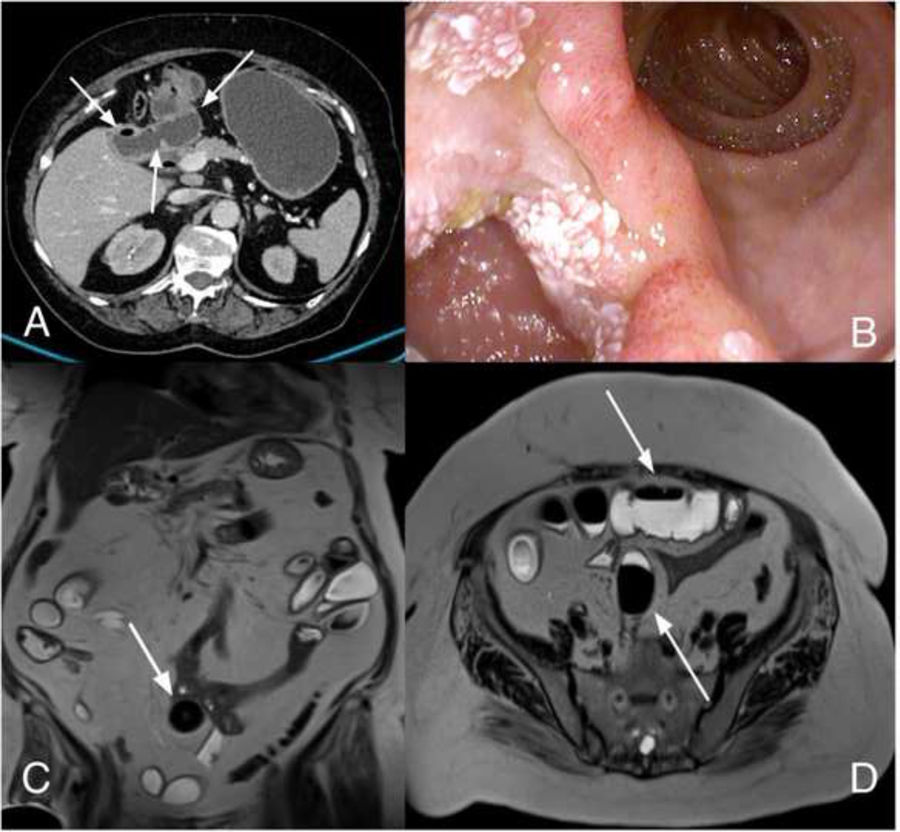
An 84-year-old woman sought medical care at our hospital center due to abdominal pain and vomiting of 5-day progression. An emergency abdominal computed tomography (CT) scan revealed proximal jejunitis with retrograde dilation of the duodenum and gastric chamber, no clear signs of mechanical bowel obstruction, and an associated cholecystoduodenal fistula (Fig. 1A). Given the laboratory results of significantly elevated acute phase reactants and the acute symptom onset, gastrointestinal infection was included in the differential diagnosis. Empiric antibiotic treatment was started, but there was no clinical improvement, and the patient continued to experience vomiting and oral intake intolerance. Further diagnostic tests were therefore continued. Gastroscopy revealed the previously viewed bilioenteric fistula in the duodenal bulb, as well as multiple “punched out” ulcers in the jejunal mucosa (Fig. 1B); biopsy identified signs of nonspecific inflammation. Given those data and the lack of treatment response, the leading differential diagnoses were Crohn’s disease and possible gallstone ileus due to the symptoms suggestive of mechanical obstruction (without an identifiable underlying cause on the latest imaging studies) and the presence of the known cholecystoduodenal fistula. Magnetic resonance enterography (MRE) identified a 3cm gallstone impacted in a jejunal segment, consistent with gallstone ileus (Fig. 1C and D). Given the patient’s poor clinical course despite the initial conservative treatment of antibiotic therapy and bowel rest, emergency surgical intervention (enterotomy) was performed through a midline laparotomy, with gallstone extraction. The patient progressed favorably, tolerating oral intake, with no pain or signs of infection, and so was discharged to her home.

A) Contrast-enhanced axial abdominal CT image, showing the cholecystoduodenal fistula (lower arrow) that connects the gallbladder (upper left arrow) to the duodenum (upper right arrow). B) Large wall defect at the level of the inferior surface of the duodenal bulb, corresponding to the cholecystoduodenal fistula, seen through the forward-viewing gastroscope.
The coronal view of the MRE image in the T2-weighted sequence with no fat suppression, shows C) the ectopic gallstone impacted in the jejunal segment.
Axial T2-weighted sequence with no fat suppression shows D) small bowel segment dilation (upper arrow) secondary to the ectopic gallstone impacted in the jejunum (lower arrow).
Gallstone ileus is a form of mechanical bowel obstruction caused by a gallstone (typically larger than 2.5cm in diameter) in the intestinal lumen. It is a rare complication of cholelithiasis and tends to present in advanced-age adults, with a predominance of women. It is associated with the presence of a bilioenteric fistula, most commonly a cholecystoduodenal fistula. Impacted gallstones are most frequently located in the distal ileum. Symptoms are usually acute, characterized by vomiting, bloating, and the absence of bowel movements.2,3 Abdominal CT is the imaging study of choice. The characteristic and specific finding is the Rigler triad, which consists of pneumobilia, signs of bowel obstruction, and an ectopic gallstone.4 The mortality rate is high, reaching 25%, and management is primarily surgical, with most cases requiring emergency enterotomy.5
Ethical considerationsThe present work is not part of a clinical trial.
The work complies with the current bioethics research regulations, given that it contains no information that could identify the patient.
Protection of humans and animalsThe authors declare that no experiments were performed on humans or animals for this article.
Data confidentialityThe authors declare they have followed the protocols of their work center in relation to the publication of patient data, preserving absolute patient confidentiality and anonymity by not specifying personal and/or pathologic data that could identify the patient. Likewise, the images in this work show no aspects that could affect patient anonymity.
Financial disclosureNo financial support was received in relation to this article.
The authors declare that there is no conflict of interest.